a name on the gate, a brother and a sister, a country
ena robert enaroberT
For Alice — who carried Barraba with her every step from the New England tableland
to the College, and from the College into a life of service.
Begin
Chapter I · The Family
A family in this country
Three surnames that come back through the country between Barraba and Bingara —
Walker, Derrick, Hodges — and a gate that finally bore them all.
By the closing decades of the nineteenth century, three surnames had settled
into the pastoral country north of the Liverpool Range — Walker,
Derrick, and Hodges. None of them were the great
squatters of the district. They were the families who do the actual work of making a
country into a place: who clear the first paddock, who put up the first slab hut,
who name the first creek crossing, and who in the slow weave of three generations
marry into one another until the three names become, in the end, one family.
This site is for that family.
It is for the dam in the bottom paddock and the corner of the front verandah where
the dog always slept. It is for the eldest brother who rode boundary, and the
youngest sister who could harmonise with anyone. It is for the women who held the
Corps together with sandwiches and faith, and the men who carried the open-air drum
into the main street on a Saturday night. It is for Ena and Robert,
whose names came to rest on the gate. And it is, most of all, for
Alice — who carried the whole of it with her, every step from
the property gate to Sydney and into a life of service.
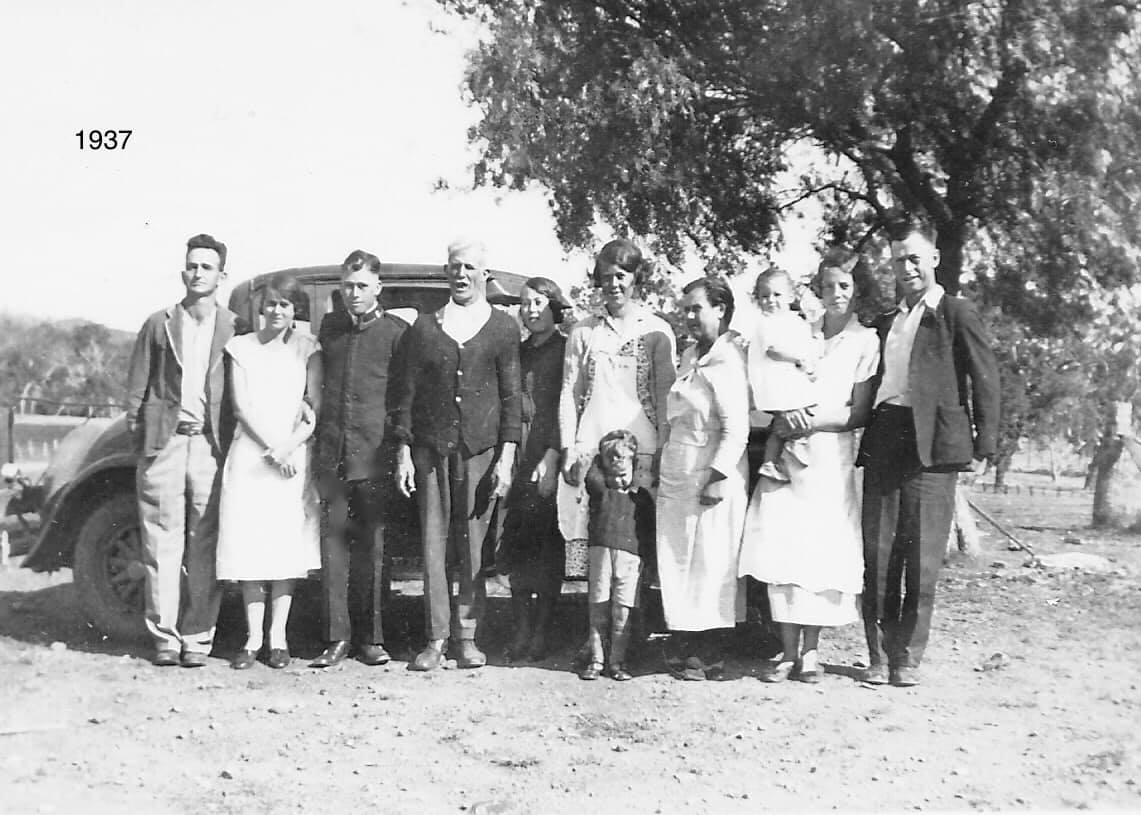
Plate I · 1937
The family beside the car, 1937. Three generations stand together — the silver-haired patriarch at centre, a young Salvation Army officer in uniform third from left, the women and children gathered close. One photograph and the whole story is already there.
Three surnames, three generations, one family.
This is Kamilaroi country, and we acknowledge it.
Chapter II · The Town
A town called Barraba
Settled in 1837, proclaimed a town in 1885, woven from wool, cattle, copper,
and the long quiet patience of a country river.
Barraba sits on the Manilla River in the New England district of northern New South Wales.
The town grew up between the granite hills as a service centre for the pastoral country around it —
merino flocks on the slopes, beef cattle along the river flats, and small mixed holdings on the
creeks. The first post office opened in 1856; the first school in 1861; the railway from Manilla
reached the town on 21 September 1908. For most of the twentieth century Barraba was a town
where everyone knew which property each child belonged to, and which family sat where in church.
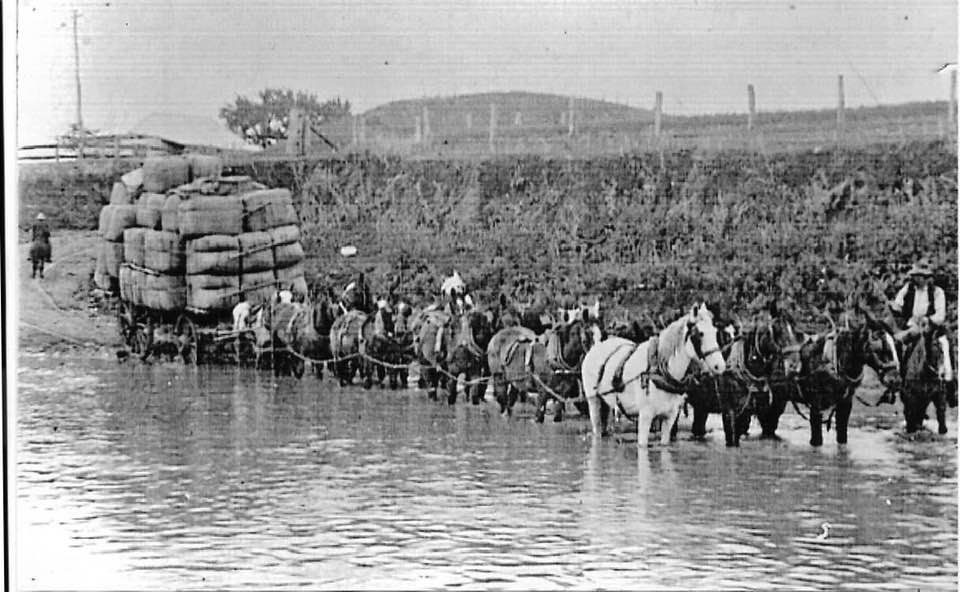
Plate II
A wool wagon piled high with bales, drawn by a long team of draught horses through a river crossing — somewhere in the district. The whole nineteenth-century pastoral economy of Barraba is in this one photograph: the wool, the horses, the river, the patient work.
1837First pastoral run, Barraba Station, taken up.
1852Town site marked out by Assistant Surveyor J.T. Gorman.
1856First Barraba Post Office opens, 1 April.
1881Rainfall recording begins at Barraba Post Office (BOM 054003) — 144 years of continuous record by 2025.
1885Barraba proclaimed a town, 20 March.
1908Railway from Manilla reaches Barraba.
1955194.3 mm of rain falls in a single day on 25 February — the town's largest recorded deluge.
1964Barraba swimming pool opens; Roy Derrick its first manager.
1984Snow falls in Barraba in July; lowest maximum temperature on record, 5.8 °C.
2004Barraba Shire amalgamated into Tamworth Regional Council.
·
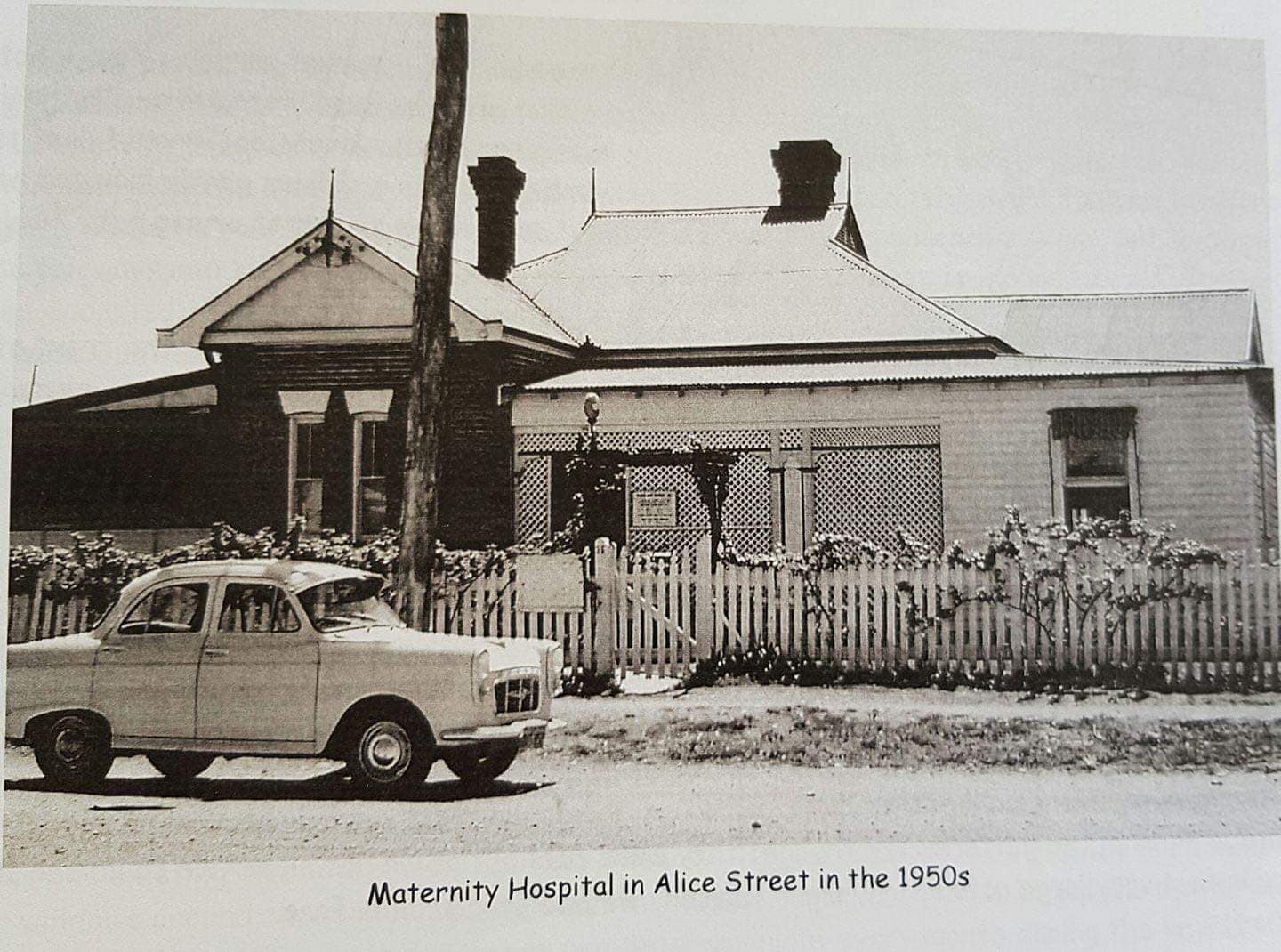
A small house on Alice Street
Plate III · 1950s
The Barraba Maternity Hospital, in Alice Street, photographed in the 1950s. A weatherboard cottage behind a white picket fence — the kind of building country towns trust their beginnings to. The street, by lovely coincidence, shares its name with Alice.
Many of the district's children of the mid-twentieth century began their lives in
this small cottage on Alice Street. Whether Alice herself was born here, or
on the property, or in Tamworth, is a question for her own telling.
Chapter III · The Three Lines
Walker. Derrick. Hodges.
Three names on grave stones, on show ribbons, on the Corps roll,
and at last on the gate of Treborane.
Each of the three lines arrived in the district by its own road. Where exactly
each line first appeared in Barraba, and which marriage first wove them together,
are questions for the family papers and the Barraba Gazette microfilm
to settle. What the public record already shows is that by the middle of the
twentieth century the three surnames were as much a part of Barraba as the river
itself: in the cemetery, in the show ring, on the school committee, and most of all
in the small hall on the side street where the Corps met every Sunday.
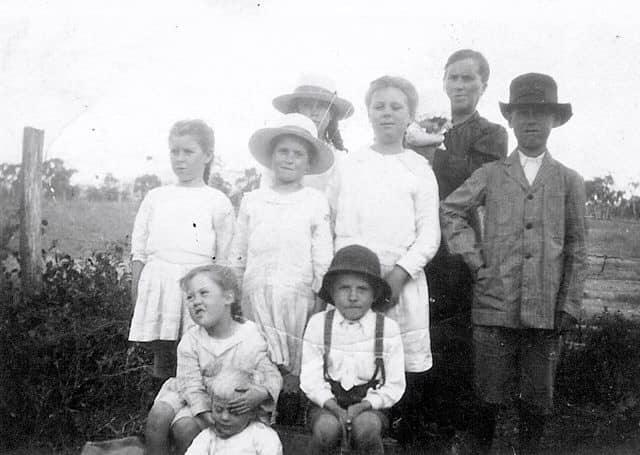
Plate IV · c. early 1900s
A group of children in pinafores and Sunday suits, posed against the fence at the edge of a paddock. An earlier generation.
Plate V · 1930s
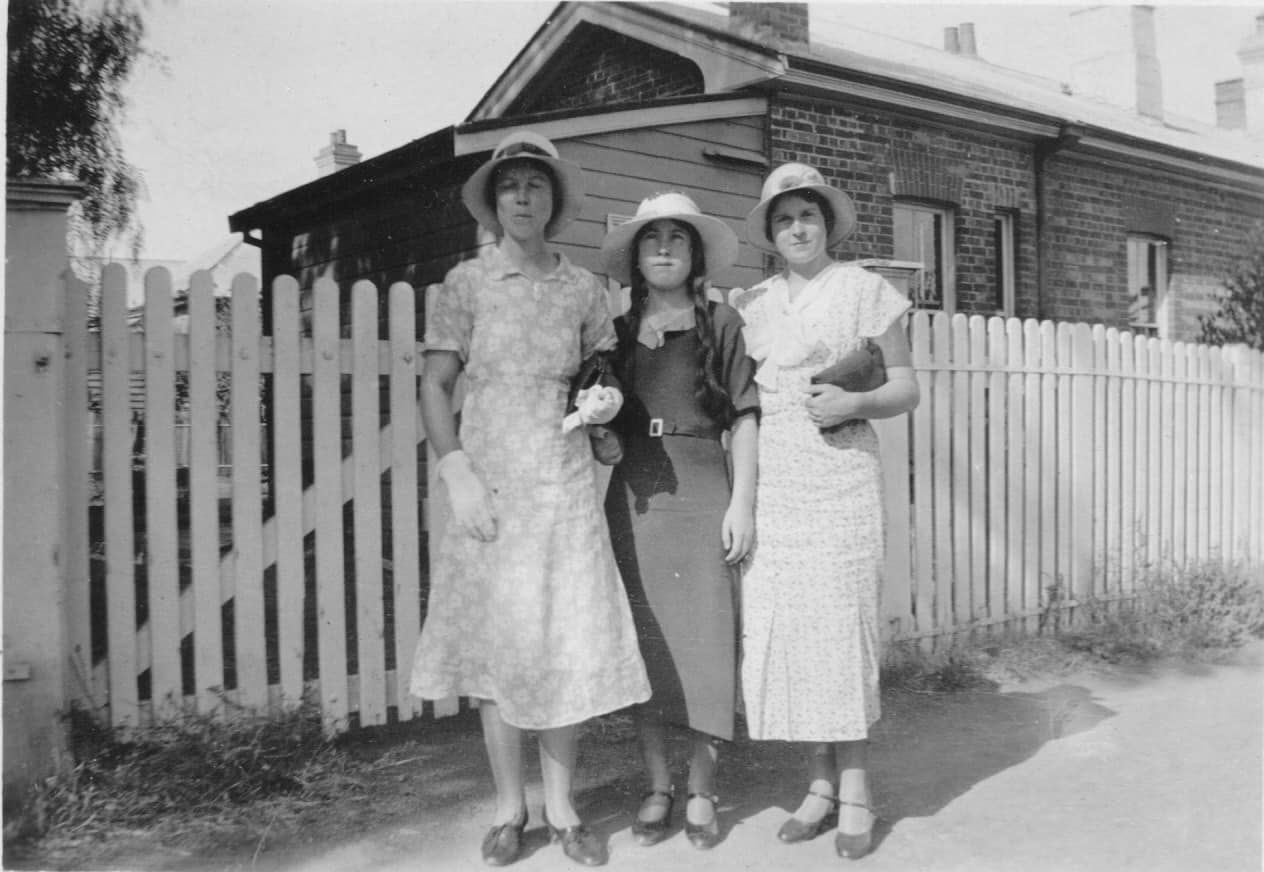
Three women in cotton-print summer dresses and hats, at the picket fence of a Federation cottage. The whole composure of the inter-war years caught in a single afternoon.
Plate VI · c. 1934
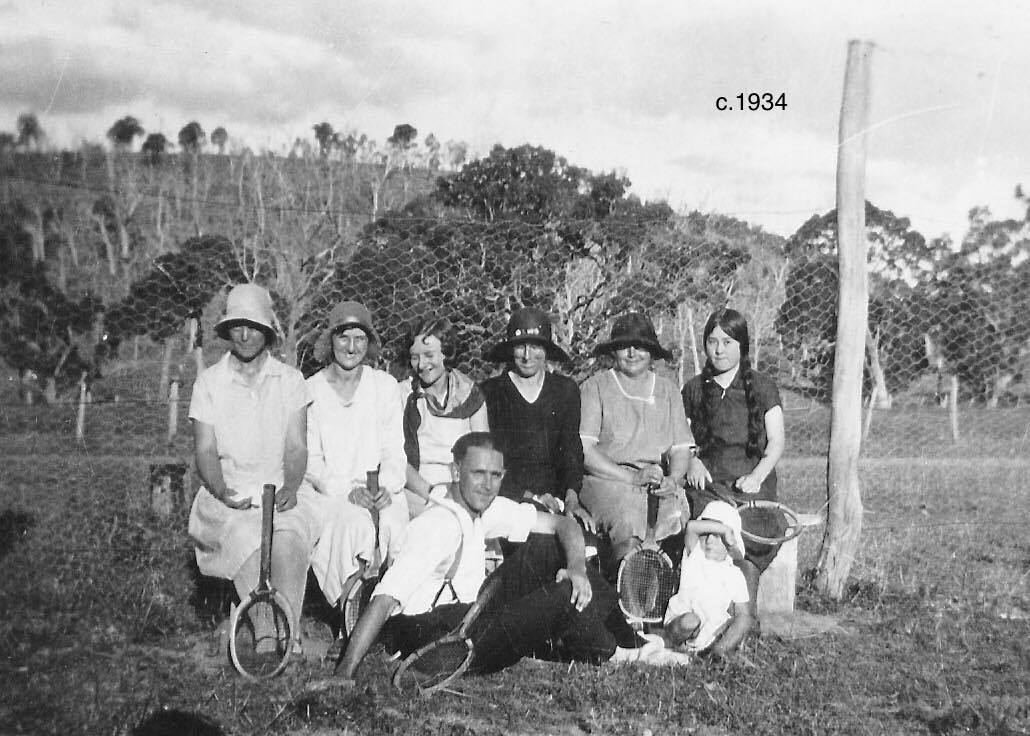
A tennis party, c. 1934. Six women in hats and white dresses, one man at their feet in shirtsleeves, a small child to the side — all with racquets in hand, the wire-netting court behind them and the tableland country rising over the ridge. A summer afternoon on a country property between the wars.
·
The Derrick line in living memory
In March 2025 the Northern Daily Leader ran a feature on
Roy Derrick of Barraba, ninety-five years young: first manager of the town
pool when it opened in 1964, swim coach of three decades, life member, and — in the
understated way of country obituaries written while the subject is still alive —
"a Barraba institution." His father was a Barraba man. Roy came home to his
father's town in the early 1950s and never left.
Roy's first wife was named Edna. The closeness of Edna to Ena
— the name on the family's gate — is one of the threads this site exists to trace.
They were not the great squatters. They were the families who did the work of making a district.
Chapter IV · The Corps
The Salvation Army at Barraba
At its heart, this is the story of a family that was — for a time —
most of the congregation.
Plate VII · late 19th century
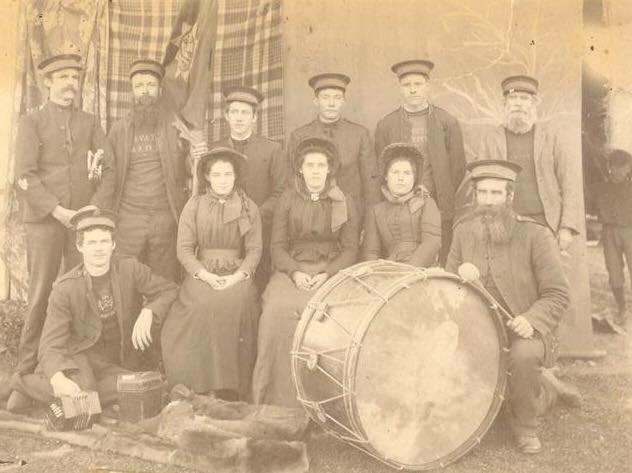
A Corps photograph from the closing years of the nineteenth century. Eleven figures — men in dark tunics, the women in their plain bonnets, the bandmaster's bass drum laid flat at the front, a concertina at the kneeling soldier's feet, the regimental flag held high behind. The dark guernsey on the standing soldier carries the word SALVATIONIST in white. Wherever exactly this was taken, it is a photograph from the heart of the movement — the same movement the family would, in time, be central to in Barraba.
In country towns the size of Barraba, a Salvation Army Corps was rarely
a large institution. It did not need to be. It was a hall on a side street, a
small brass band, an open-air meeting in the main street on a Saturday evening,
and a roll of soldiers and adherents who knew one another's children by their
first names. The Barraba Corps was that kind of Corps. And for a number of years
in the middle of the twentieth century, the extended Walker–Derrick–Hodges
family was, in the most literal sense, the Corps.
They sat together in the meetings. They stood together at the mercy seat.
Their boys played in the band when there was a band; their girls sang in the
Songsters when there were Songsters. The women ran the league of mercy,
visiting the elderly and the sick across a district that could be two hours
between farm gates. The men carried the open-air drum into the main street on
a Saturday night and stood under the verandah of the Royal Hotel while a
cornet played O Boundless Salvation.
It was, in those years, a thoroughly practical Christianity. There were
sandwiches after the meeting. There was a working bee when the hall roof needed
re-iron. There was a tin on the kitchen mantelpiece for the self-denial appeal.
There were Sunday-school certificates with gilt borders, and a piano that
needed tuning, and a tea urn that someone always remembered to put on. The
Walker women, the Derrick women, the Hodges women — they made the Corps run.
And out of that Corps — out of that small hall on that side street, out of that
family's quiet weekly faithfulness — a daughter would in time go down to
Sydney to the College, and would put on the uniform with the red shoulder
flashes and the small white "S" at the collar, and would be commissioned as
an officer of The Salvation Army.
The family was not part of the Corps. For a number of years, the family was the Corps.
— Family recollection (to be confirmed)
What we hope to record here
HallWhen the Barraba Corps was founded; where the hall stood; when it closed (if it has) and what became of the building.
RollThe soldiers' roll across the decades the family was prominent — names, ranks, years of service.
OfficersThe Corps Officers who served at Barraba in the family's years — many of whom would have boarded with family.
SongsThe hymns and songs Alice remembers from the meetings of her childhood.
OutreachThe league of mercy, the self-denial appeals, the harvest festivals, the open-air meetings on Saturday nights.
The Salvation Army's Australia Eastern Territory holds Corps records
and Officer rolls at its Heritage Centre. A formal enquiry to
heritage.aue@salvationarmy.org.au can recover the Corps' founding
and closing dates, lists of Corps Officers by year, and any surviving photographs.
Chapter V · The Property
A gate, two names, one country
Treborane. Read it backwards.
In the small pastoral country between Barraba and Bingara, the family
property went by a name that nobody else in Australia carried. It was — as
Alice and her cousins always knew, in the way these things are known in
families — Ena Robert spelled backwards. A property named for
two siblings. A small piece of mirror-writing for a small piece of country.
Plate VIII · mid-20th century
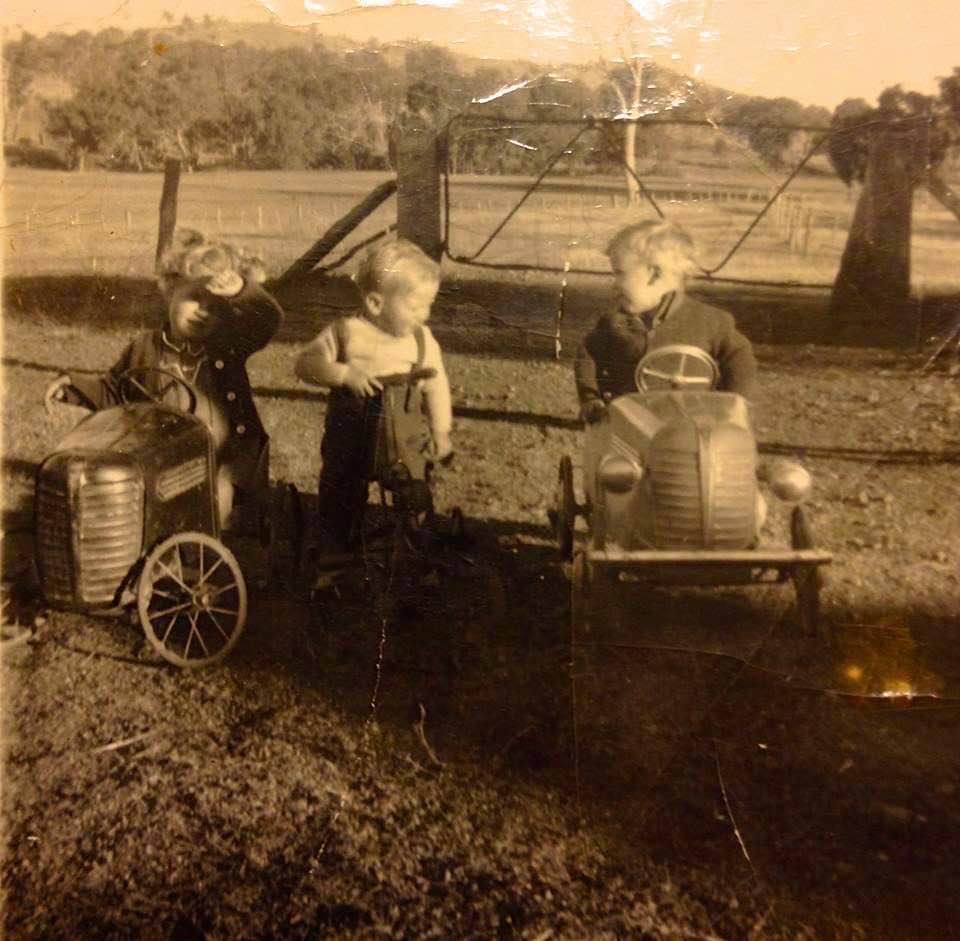
Three small children at play with pedal tractors in a paddock — one waving at the camera, one bent intently over a steering wheel, one peering out from the cab of his own. Childhood on a country property, in miniature.
The size of the holding, the year the name first went on the gate, the
improvements built, the kind of operation it ran — wool, cattle, mixed —
these details will be confirmed from family memory, the NSW Land Registry
Historical Land Records Viewer, and the rate books of the former Barraba Shire.
Ena and Robert
Ena was Alice's mother. Robert was her brother. The naming of the place was an
act of love between siblings, carried forward as an act of love by the children
who grew up on the place named for them.
Ena's life dates, Robert's life dates, their parents, the wider sibling group,
and the exact year the property was named — all to be confirmed from family
records and the NSW BDM historical indexes.
Photograph wanted
Treborane homestead — the long view from the gate
to be supplied from family album
·
Chapter VI · Weather and Land
The rain gauge at the gate
A hundred and forty-four years of rain falling on the same patch of
tableland, and somebody — for most of those years — writing the number down.
The Bureau of Meteorology has kept a rainfall record at Barraba since
March 1881. Through 2025 that record stretches across 144 continuous years —
through Federation, two world wars, the Federation drought, the Millennium
drought, and every storm and snow event between. The station today is known as
Barraba (Clifton Lane), site 054003, and it remains one of the
longer continuous rainfall records on the New England tableland.
An open question for this site is whether Treborane itself ever carried a
registered BOM rainfall gauge — many country properties did, and many still do.
Those small private stations are the unseen backbone of Australia's climate
record, kept faithfully by farming families across generations. A direct enquiry
to BOM Climate Services (climatedata@bom.gov.au) will settle the question.
What the gauge has seen
1898First snowstorm recorded in Barraba.
1915Cyclonic winds on 6 February — three inches of rain in half an hour, sheds destroyed.
1955194.3 mm of rain on 25 February — the largest single day in the record.
1984Snow falls in Barraba in July; the lowest maximum temperature on record, 5.8 °C on 3 July.
Somebody, every morning, walked out to the gauge and read it. That is how a country keeps its memory.
Chapter VII · Alice
From the hall on the side street to the College
A daughter of the Corps, a daughter of the family, who answered a call
that had been quietly forming in her since she was old enough to hold a
songbook.
Plate IX
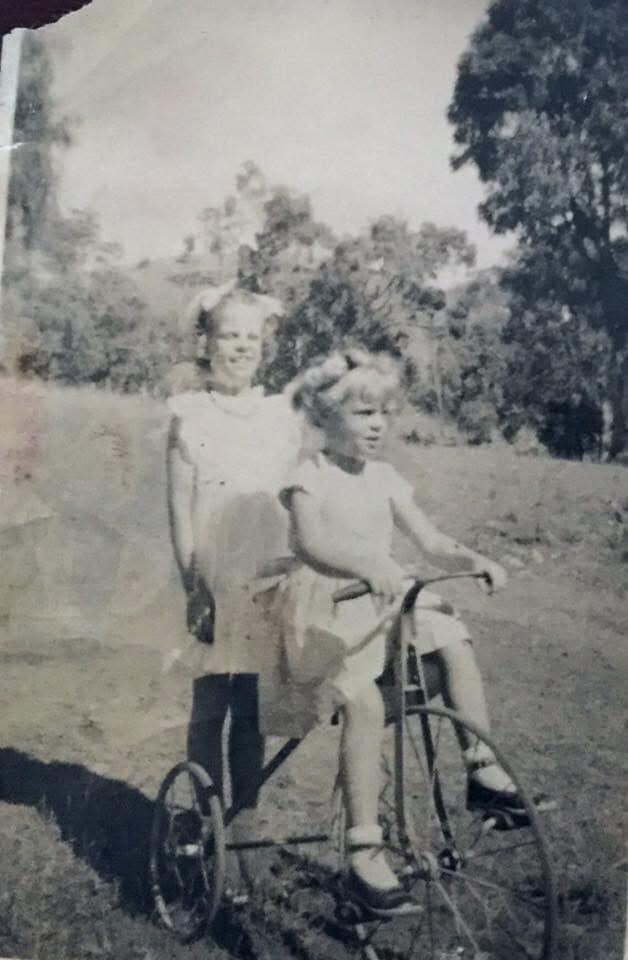
Two small girls in summer dresses, one perched on a tricycle, the other at her shoulder. The country sloping away behind them.
Alice grew up at Treborane, in the Corps, in the family. She knew the road from
the property gate into Barraba in every weather. She knew the hymns by heart
before she knew the words for what the hymns were doing in her. She knew the
faces in the meeting on a Sunday morning, and which farmer's wife had baked
for the supper, and where her own family sat.
And in time she went south.
She went down to Sydney to the College of Officer Training of The Salvation
Army, then in its long-established home in the Eastern Territory. She took the
cadet's uniform. She took the years of formation that the College required —
doctrine, ministry, music, practical placement in the Corps of the inner city
and the suburbs. And in due season she was commissioned, and she was
appointed, and she put on the officer's epaulettes for the
first time.
She had carried Barraba with her every step of the way.
Plate X · mid-1950s
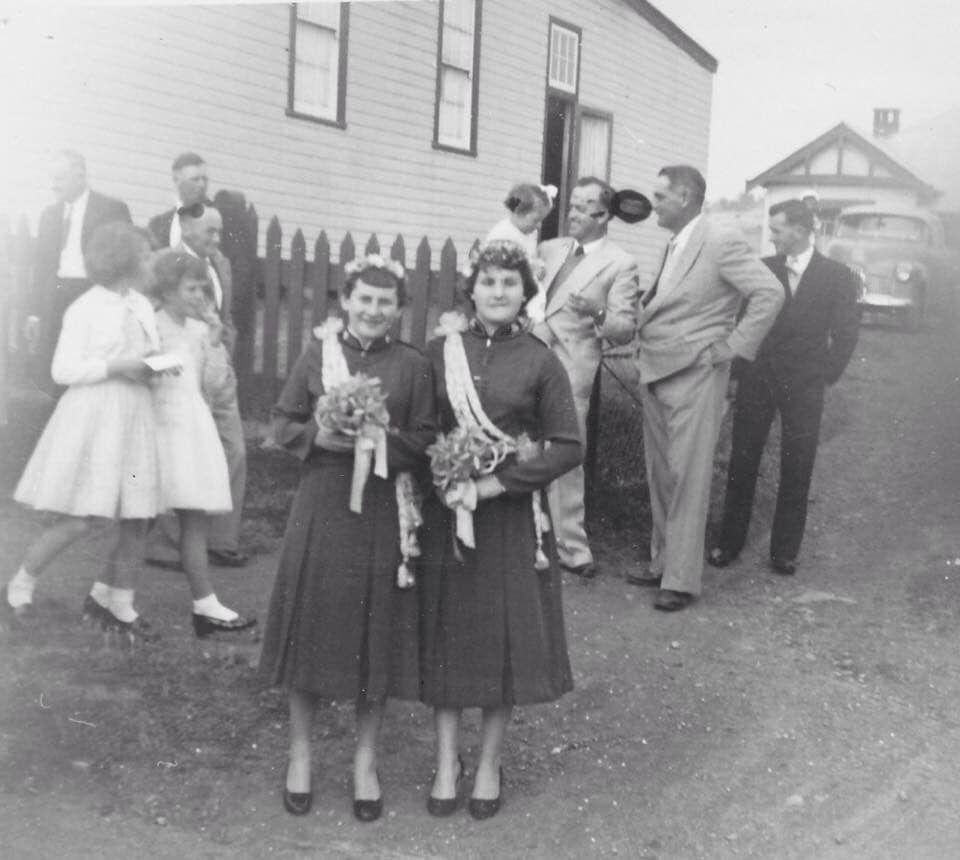
Two young women in formal dresses, holding flowers, with floral sashes and white head-pieces — a Salvation Army or church-hall occasion of the mid-1950s. Behind them the gathering: men in suits, a child being lifted up for a closer look, an old car at the kerb.
·
A life of service
The years of Alice's training, her session name, the appointments she held
across her years as an officer, the Corps and centres in which she served, the
partner in ministry she may have served alongside, and the moments she would
most want remembered here — all to be recorded directly from Alice and from
family papers.
She had carried Barraba with her every step of the way.
It is for Alice that this site exists. The whole long sweep of the country and
the town and the families and the Corps and the property and the rain on the
gauge and the brass band on a Saturday night — all of it, in the end, gathers
toward the one daughter who took the calling forward.
Chapter VIII · Today
Barraba now
A town of one thousand and thirty-five souls, a forty-metre mural on a
wheat silo, a ninety-five-year-old who still does laps at the pool he opened.
At the 2021 census, Barraba's population stood at 1,035.
The wheat silos on the edge of town now carry a forty-metre mural by Fintan Magee
— "The Water Diviner" — completed in twenty-four days during April 2019, and now
the twenty-eighth entry in the Australian Silo Art Trail. The Playhouse Hotel,
built around 1905 and restored by a former actor whose grandfather once owned
Warabah Station out on the Woodsreef road, runs an eighty-seat cinema in what
used to be the dining room. And Roy Derrick, ninety-five last March, still does
his laps at the pool he opened in 1964.
The Barraba Show committee still runs the show. The Barraba Historical Museum
still keeps its quiet vigil on Queen Street. The Manilla River still runs.
The Nandewar ranges still rise in the west. And somewhere down a side road
out of town, the gate of Treborane still carries the name of a brother and a sister.
Photograph wanted
The Water Diviner — Barraba's silo mural by Fintan Magee, 2019
to be added — Wikimedia Commons or a family visit
Epilogue
For the next generation
This site is intentionally unfinished. It is the beginning of a longer
conversation — between Alice and her children, between the cousins and the
Hodges Family group, between the family and the small archives in Tamworth and
Sydney that still hold pieces of this story.
If you have a photograph, a date, a name, a correction, a memory, or a
prayer-meeting story that belongs here — please send it. Nothing is too small.
The shape of the page below is meant to be filled.